

Unlearning Safety
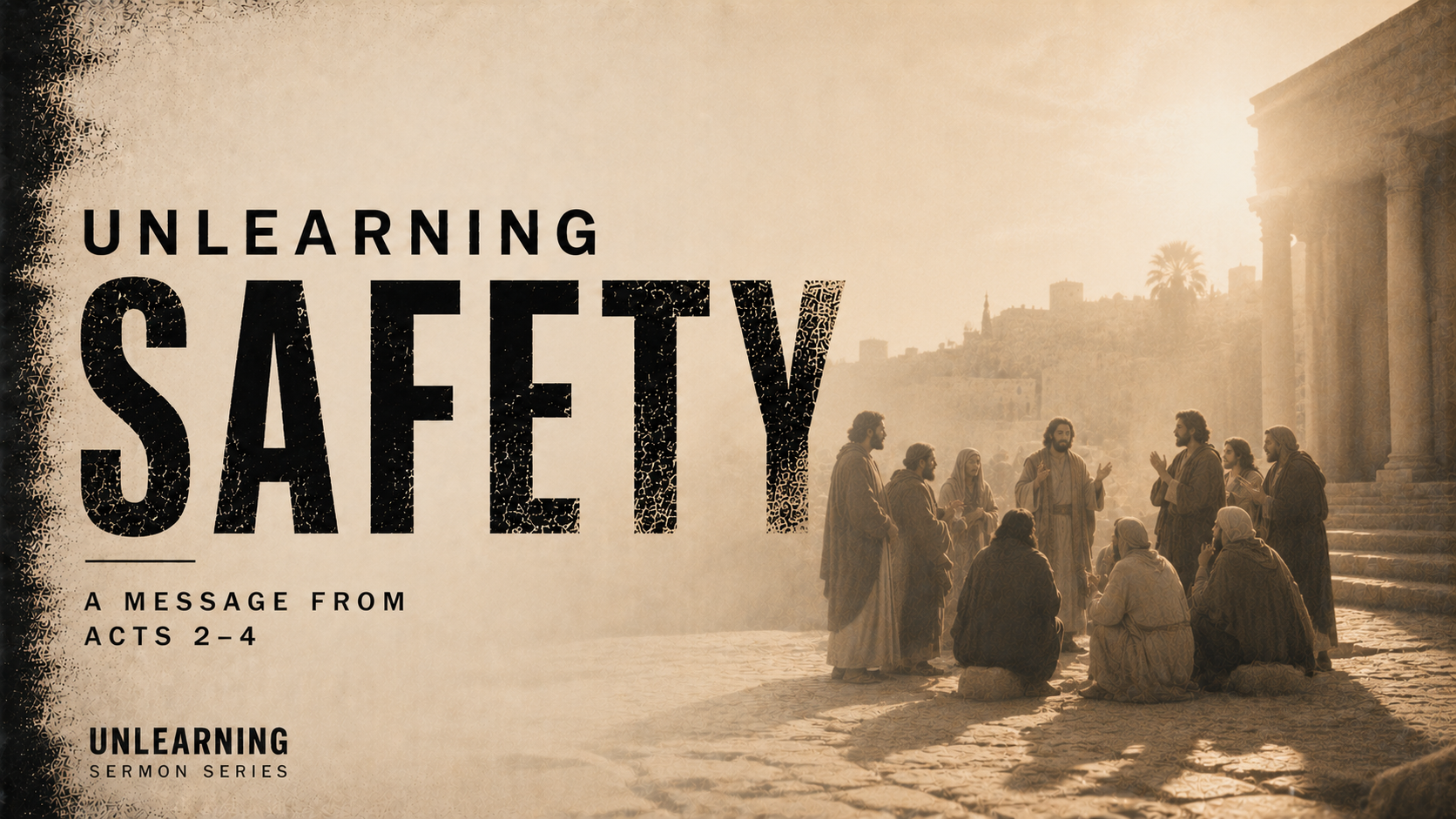
Maybe Following Jesus Isn’t Supposed to Make You Feel Safe
We really like safe.
Safe cars. Safe neighborhoods. Safe schools. Safe investments. Safe relationships.
We buckle our seatbelts. We check the weather. We read the reviews.
Some of us don’t just have a backup plan. We have a backup plan for our backup plan. And if that fails, there’s probably a spreadsheet somewhere.
There is nothing wrong with wanting to be safe. Some things in life should be safe. We need healthy boundaries. We need wisdom. We should not go looking for danger just to prove that we have faith.
But here is the uncomfortable question:
What if following Jesus doesn’t always make our lives safer?
That is what I keep seeing in Acts 2–4.
What Acts 2–4 Teaches Us About Following Jesus
In Acts 2, the disciples encounter the presence and power of the Holy Spirit. Peter—the same man who denied Jesus three times—stands before a crowd and boldly proclaims that Jesus is Lord.
People are amazed. Some are confused. Others make fun of the disciples.
Yet thousands respond to the gospel, and a new community begins to form around the story of Jesus. These believers devote themselves to the apostles’ teaching, fellowship, shared meals, and prayer. They care for one another, practice generosity, and worship together.
Then, in Acts 3, Peter and John encounter a man who has been unable to walk since birth. They do not have silver or gold to offer him, but they make themselves available to what God wants to do. Through the power of Jesus, the man is healed.
By Acts 4, Peter and John are arrested, questioned, and threatened by the religious authorities.
Following Jesus has not made their lives safer.
It has made them more available.
The Early Church Prayed for Boldness, Not Safety
After Peter and John are released, they return to the other believers and tell them what happened. You might expect the church to pray:
“God, please make this less dangerous.”
“God, protect us from anyone who might oppose us.”
“God, give us a safer and more predictable way to follow You.”
But that is not what they pray.
Instead, they ask God to enable them to speak His Word with boldness. They do not ask Him to eliminate the risk. They ask Him to help them remain faithful in the middle of it.
That reveals an important distinction in the Christian life:
God’s presence does not always make us safe. It makes us secure.
Safety says, “Nothing bad can happen to me.”
Security says, “Whatever happens, I belong to Jesus.”
Safety says, “I need to know how this will turn out.”
Security says, “I don’t know how this will turn out, but I know who is with me.”
Safety depends on controlling our circumstances. Security grows from trusting the presence and faithfulness of Jesus.
Waiting for Safety Can Keep Us From Obeying God
If we believe we must feel completely safe before obeying God, we may spend our entire lives waiting.
Waiting until we have enough money.
Enough certainty.
Enough confidence.
Enough experience.
Enough information.
Enough control.
But the first Christians did not wait until their circumstances were safe. They encountered God, were filled with the Holy Spirit, were formed by the story of Jesus, and found strength in Christian community.
Then they became available.
Available to speak.
Available to serve.
Available to notice people others overlooked.
Available to give.
Available to forgive.
Available to go.
Available to participate in what God was already doing.
The question was not whether they could eliminate every risk. The question was whether they trusted Jesus enough to take the next faithful step.
When Safety Becomes a Substitute for Trust
Maybe this is where the entire Unlearning series has been taking us.
We have been unlearning control, comfort, self-sufficiency, excuses, scarcity, image management, noise, casual faith, and independence.
Now we must unlearn safety.
Not because safety is bad. Wisdom matters. Healthy boundaries matter. Protecting vulnerable people matters.
But sometimes our desire for safety becomes a respectable way of avoiding trust.
We tell ourselves that we are simply being careful when we are really afraid to obey. We continue gathering information when God has already made the next step clear. We keep waiting for certainty when Jesus is asking us to trust Him.
Maybe the most important question is not:
“God, can You make this safe?”
Maybe the better question is:
“God, what are You inviting me to do—and can I trust You enough to take the next step?”
What Is Your Next Faithful Step?
Your next step may not be dramatic.
It may be starting a difficult conversation.
Offering an apology.
Choosing forgiveness.
Practicing generosity.
Serving someone in need.
Asking for help.
Noticing someone who is lonely.
Introducing yourself to the neighbor you have waved at for three years but never actually met.
It might be something incredibly ordinary—because mission usually is.
The Holy Spirit does not fill us merely so that we can have an inspiring experience and then return to life as usual.
The Spirit fills us and sends us.
Encounter becomes formation.
Formation leads us into community.
Community prepares us for participation.
Participation becomes mission.
Sunday becomes Monday, and ordinary people become available to an extraordinary God.
Following Jesus Means Becoming Available
Perhaps the goal of the Christian life is not to construct a life in which nothing difficult can ever happen.
Perhaps the goal is to become the kind of people who can say:
“I don’t know what is going to happen. But I know Jesus is with me, and I am available.”
That kind of availability is not reckless. It is rooted in the presence of God, formed through the truth of Scripture, and sustained within the community of faith.
Following Jesus may not always make your life safer. It may lead you beyond comfort, certainty, and control.
But it also leads you into a deeper kind of security—the confidence that whatever happens, you belong to Jesus and He will never leave you.
That may be a far better kind of security than safety could ever provide.
Questions for Reflection
Where has your desire for safety made it difficult to trust or obey God?
What is God inviting you to do that you have been postponing until you feel more certain?
How could the presence of the Holy Spirit and the support of Christian community help you take that step?
What would it look like for you to tell Jesus, “I am available”?