

Unlearning Self-Sufficiency
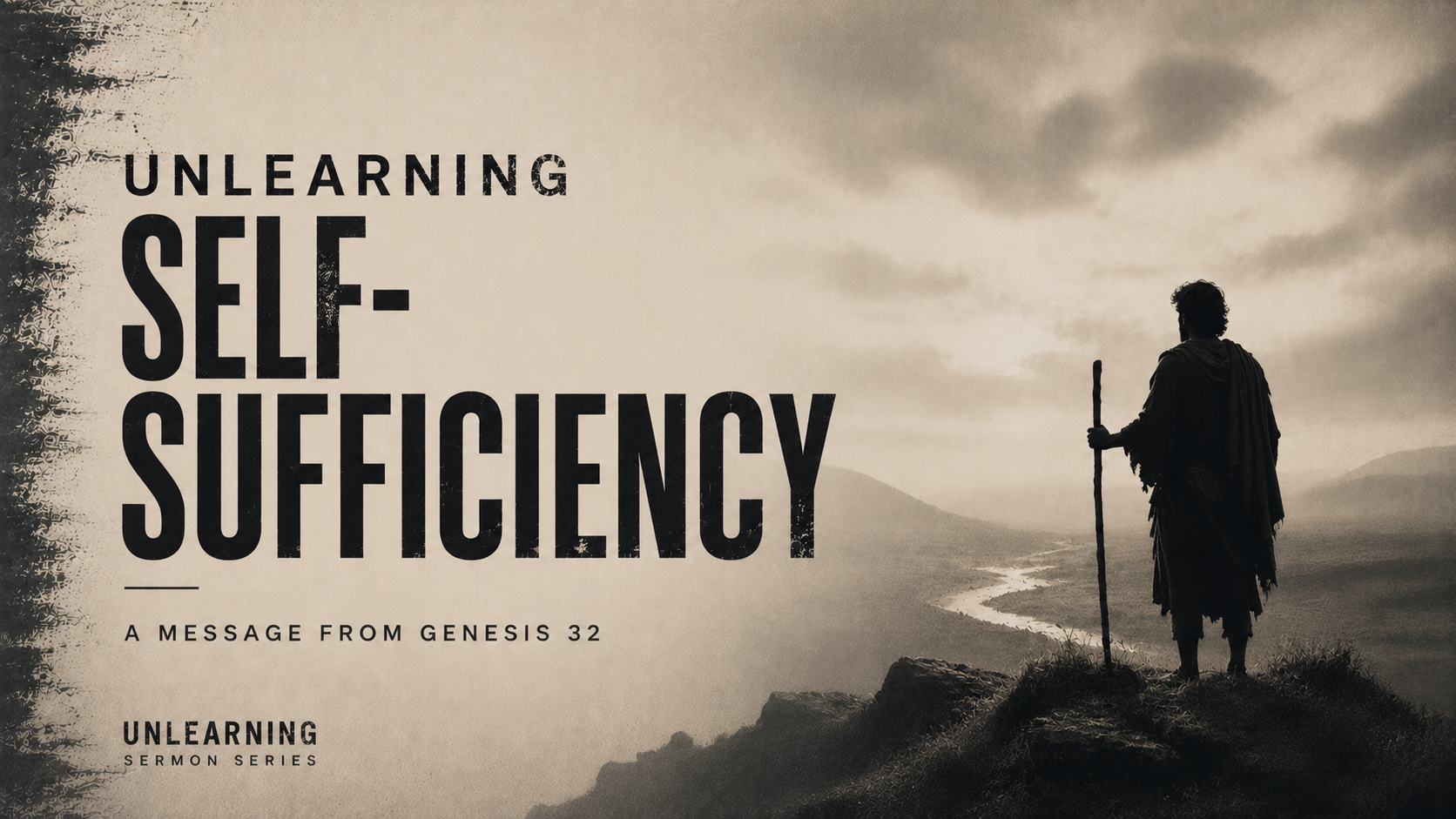
What If Your Greatest Strength Is Keeping You from God?
Most of us admire self-sufficiency.
We celebrate people who seem to have it all together—the ones who solve problems, work hard, plan ahead, and rarely need help. From an early age, we are taught that independence is a sign of maturity.
But what happens when our greatest strength becomes the very thing keeping us from fully trusting God?
That is the tension at the heart of Jacob’s story in Genesis 32.
Jacob’s Struggle with Self-Sufficiency
Jacob spent much of his life relying on his intelligence, determination, and ability to outmaneuver the people around him.
He was capable, resourceful, and successful. He knew how to recognize an opportunity and turn circumstances to his advantage. Yet beneath all his competence was a heart that struggled to trust God completely.
Jacob believed in God, but he also believed he needed to protect himself.
He prayed—but he still needed a backup plan.
He trusted God—but only after he had calculated every possible outcome.
He wanted God’s blessing, but he often tried to secure that blessing through his own strength.
That pattern reaches a breaking point in Genesis 32.
Jacob Prepares to Meet Esau
Jacob is returning home when he learns that his brother Esau is coming to meet him with four hundred men.
Years earlier, Jacob had deceived Esau and stolen the blessing that belonged to him. Now Jacob fears that Esau is coming for revenge.
Jacob does what he has always done: he develops a strategy.
He divides his family and possessions into separate groups. He sends expensive gifts ahead of him. He prepares for the possibility that one group might escape if another is attacked.
Jacob also prays.
His prayer is sincere. He remembers God’s promises, acknowledges that he is unworthy of God’s faithfulness, and asks God for protection.
But after praying, Jacob immediately returns to planning.
His lips express trust in God, while his actions reveal how deeply he still trusts himself.
Planning is not wrong. Wisdom and preparation matter. The problem is not that Jacob makes a plan. The problem is that his sense of security still rests in his own ability to control the outcome.
Jacob Wrestles with God
That night, Jacob sends everyone else across the river and remains behind alone.
Then a mysterious man begins wrestling with him.
The struggle continues until daybreak. Jacob, who has spent his entire life fighting to secure his future, is now locked in a struggle he cannot win.
With one touch, the man dislocates Jacob’s hip.
The part of Jacob that had carried him through life—his strength, mobility, and ability to escape—is suddenly weakened.
Yet Jacob refuses to let go.
“I will not let you go unless you bless me.”
—Genesis 32:26
Jacob had spent years trying to obtain blessing through manipulation, deception, and determination. Now he can no longer seize the blessing through strength. He can only cling to God and receive it as a gift.
Why Did God Give Jacob a New Name?
The man asks Jacob:
“What is your name?”
God already knows his name. The question forces Jacob to acknowledge who he has been.
The name Jacob was associated with grasping, striving, and taking hold. Jacob had lived as someone who believed he had to fight for everything he received.
But God gives him a new name: Israel.
Jacob walks away from the encounter with three things:
A new name
A blessing
A limp
The blessing does not come because Jacob proves how strong he is. It comes when his strength is no longer enough.
When Strength Becomes a Spiritual Barrier
Our strengths are gifts from God. Intelligence, determination, leadership, discipline, planning, and problem-solving can all be used for good.
But even a good gift can become spiritually dangerous when it convinces us that we do not need God or anyone else.
Self-sufficiency says:
“I can handle this.”
“I do not need help.”
“I will figure it out.”
“I can protect myself.”
“I can control what happens next.”
Faith says:
“I will act responsibly, but I cannot control the outcome.”
“I will use the strength God has given me, but I will not worship it.”
“I will prepare wisely, but my security rests in God.”
“I do not have to carry this alone.”
Sometimes God allows our strength to fail—not to punish us, but to free us from the illusion that we were ever enough on our own.
Dependence on God Is Not Weakness
The good news of the gospel is that Jesus never asked us to carry life by ourselves.
He invites the weary, the burdened, and the exhausted to come to him. He does not say, “Become stronger and then come.” He invites us to come precisely because we are unable to carry everything on our own.
Communion reminds us of this every time we receive the bread and the cup.
We come empty-handed.
We do not bring our achievements, qualifications, strategies, or strength to the table. We come because everything we truly need has already been provided through Jesus Christ.
The bread reminds us that his body was given for us.
The cup reminds us that his blood was shed for us.
We receive what we could never provide for ourselves.
True Strength Begins with Surrender
Perhaps the greatest act of faith is not becoming stronger.
Perhaps it is finally admitting that we do not have to be.
The apostle Paul discovered this when he wrote:
“For when I am weak, then I am strong.”
—2 Corinthians 12:10
In God’s Kingdom, dependence is not failure. It is the beginning of true strength.
Jacob entered the night standing on his own strength. He left leaning on a staff.
He entered as someone who had spent his life grasping for blessing. He left having received it.
He entered believing that his future depended on his ability to control what happened next. He left knowing that his future rested in the hands of God.
The limp was not evidence that God had abandoned Jacob.
It was a lifelong reminder that Jacob no longer had to rely solely on himself.